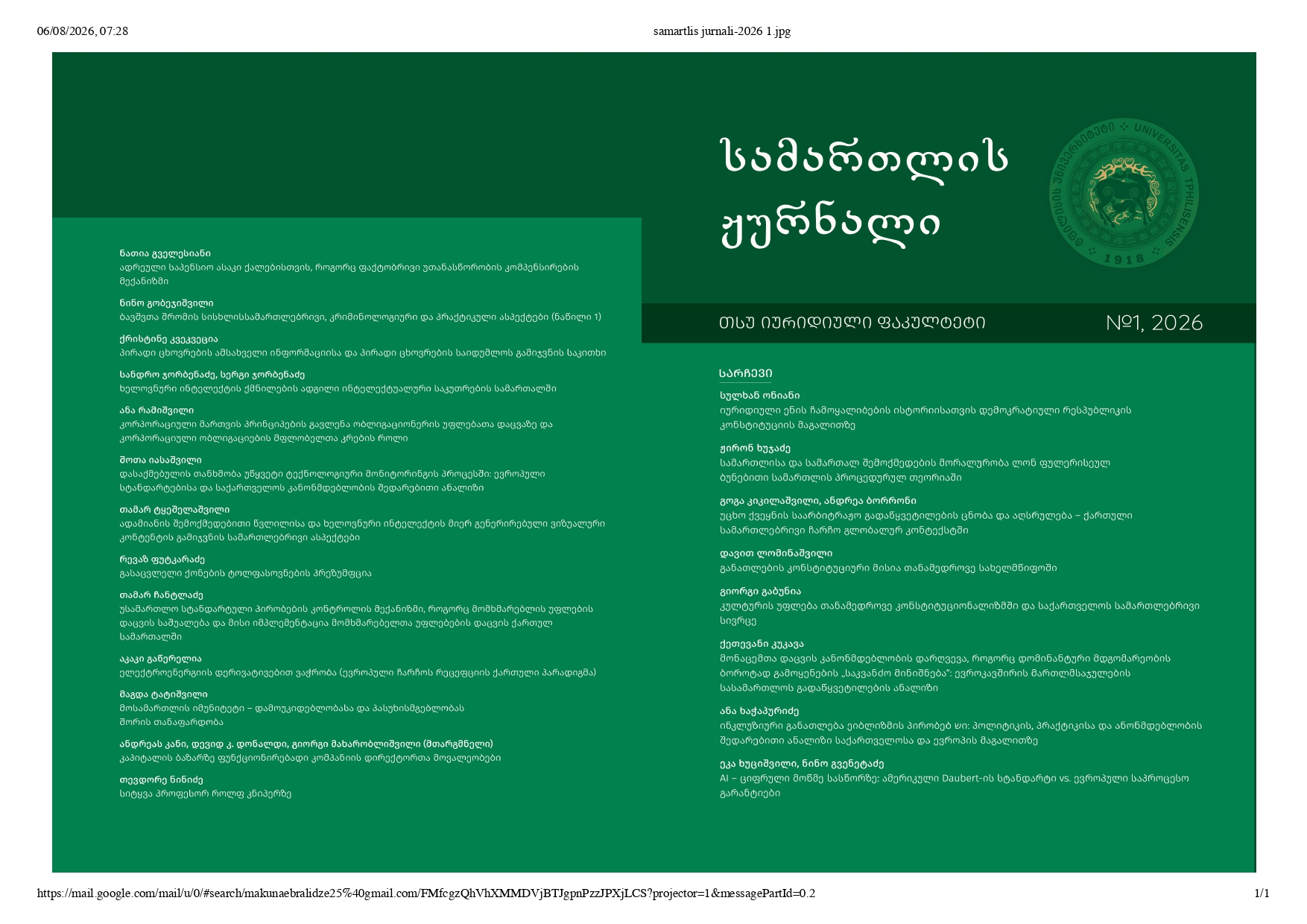
Early Retirement Age for Women as a Mechanism for Compensating De Facto Inequality
DOI:
https://doi.org/10.60131/jlaw.1.2026.11874Keywords:
Retirement pension, retirement or pensionable age, de facto equality, temporary special measures, the rights of older women, gender pay gap, unpaid work.Abstract
The equal realization of the abilities and opportunities of women and men remains a challenge not only in Georgia but also in countries with developed democracies. Obstructive circumstances arbitrarily erected within the social and cultural microclimate, hinder the translation of de jure, that is, formal legal equality, into de facto, that is, real and substantive equality between the sexes. When, due to the prevailing social environment in a country, the legal and factual realities concerning equality between women and men are not synchronized, it becomes necessary to introduce, on a temporary basis, differential treatment on the grounds of sex through incentive-based interventions. It is precisely the socio-economic inequality experienced by women that stimulates the establishment of a differentiated retirement age. The difference in retirement age between women and men has historical, social, cultural, and economic origins and, through dynamic and evolutionary development, has gradually moved toward equalization. The article examines the compatibility of the differentiated retirement age established for women and men with the right to equality, the preconditions that justify the introduction of such differentiation, the parameters used at the European level to assess it, and whether there exists a pressing social need in Georgia to maintain different retirement ages based on sex.
References
1. Constitution of Georgia, Departments of Parliament, 31-33, 24/08/1995.
2. Georgian Law on “State Pensions”, LHG, 56, 28/12/2005.
3. Ruling No. 2/7/1258 of 22 February 2018 of the Constitutional Court of Georgia in the case “Citizen of Georgia Giorgi Vashadze v. Parliament of Georgia”.
4. Operational Record No. 1/7/1320 of the Constitutional Court of Georgia dated 5 June 2020 in the case “Elga Maisuradze, Irma Ginturi, and Leri Todadze v. the Parliament of Georgia”.
5. Judgement No. 3/3/1526 of the Constitutional Court of Georgia dated 25 September 2020 in the case “NGO Political Association of Citizens “New Political Center”, Herman Sabo, Zurab Girchi Japaridze, and Ana Chikovani v. the Parliament of Georgia”.
6. Recording Notice No. 2/6/1609 of 23 December 2022 of the Constitutional Court of Georgia in the case “Budu Shekiladze v. Parliament of Georgia”.
7. The online broadcast of the Constitutional Court of Georgia in the case “Budu Shejiladze v. the Parliament of Georgia”.
8. The “amicus curiae” opinion submitted to the Constitutional Court of Georgia in the case “Budu Shekiladze v. Parliament of Georgia” on May 25, 2023, by the NGO “Georgian Young Lawyers’ Association” and the NGO “Safar”.
9. Convention on the Elimination of All Forms of Discrimination against Women, 1979.
10.Women spend five times more on unpaid care work compared to men in Georgia, <https://georgia.unwomen.org/ka/stories/akhali-ambebi/2022/12/sakartveloshi-aunazghaurebel-zrunvis-shromas-kalebi-5-jer-met-dros-utmoben-vidre-katsebi (In Georgian).
11. UN Women, Time to Care: Women’s Unpaid Care Work and the Inequality Crisis in Georgia (In Georgian).
12.Why does the retirement age differ between women and men in Georgia? <https://www.allnews.ge/ekonomika/155436-ratom-gansxvavdeba-kalisa-da-mamakacis-sapensio-asaki-sakartveloshi/ (In Georgian).
13. National Statistics Office of Georgia, Women and Men in Georgia, Statistical Publication, 2025 (In Georgian).
14. Gender Impact Assessment of Labor Law Reform, Gender Equality Council of the Parliament of Georgia, 2017 (In Georgian).
15. Council Directive (79/7/EEC) of 19 December 1978 on the Progressive Implementation of the Principle of Equal Treatment for Men and Women in Matters of Social Security.
16. Arza C., the Gender Dimensions of Pension Systems, Policies and Constraints for the Protection of Older Women, 2015
17. Barigozzi F., Cremer H., Lozachmeur J.-M., Gender wage and longevity gaps and the design of retirement systems, January 2021, revised February 2023.
18. Ciminelli G., Schwellnus C., Stadler B., Sticky Floors or Glass Ceilings? The Role of Human Capital, Working Time Flexibility and Discrimination in the Gender Wage Gap, OECD Economics Department Working Papers No. 1668, 2021.
19. Jamieson J., Ling Z., Mehta K., Howell J., the ‘Second Shift’ in Emergency Medicine: Strengths and Barriers of the Gendered Double Burden, Emergency Medicine Australasia37, no. 5 (2025).
20. Moraru and Marin v. Romania, [2023] ECHR.
21. C-614/11 Niederösterreichische Landes-Landwirtschaftskammer v Anneliese Kuso, [2013], ECR, CJEU.
22. C-356/09, Pensionsversicherungsanstalt v Christine Kleist, [2010], ECR, CJEU.
23. Stec and Others v. the United Kingdom, [2006] ECHR.
24. C-152/84, M. H. Marshall v. Southampton and South-West Hampshire Area Health Authority (Teaching), [1986], ECR, CJEU.
25. CiberCuba Editorial Team, https://en.cibercuba.com/noticias/2025-07-31-u1-e208933-s27061-nid308139-gobierno-cubano-ratifica-edad-jubilacion.
26. EIGE, Gender Equality Index 2025, Sharper Data for a Changing World, Publications Office of the European Union, Luxembourg, 2025.
27. EIGE, Gender in Poverty and Social Inclusion, Publications Office of the European Union, Luxembourg, 2016.
28. European Commission, 2025 Report on Gender Equality in the EU, 2025.
29. Kellner G., “What is the Retirement Age for Women?“, 2022. <https://retirable.com/advice/lifestyle/retirement-age-for-women.
31. NCPSSM, “Women and Retirement: The Gender Gap Persists: Why Women Face a Gender Gap in Retirement Savings”, 2021, https://www.ncpssm.org/documents/issue-briefs/women-and-retirement-the-gender-gap-persists/.
32. Pensions at a Glance 2025, OECD and G20 Indicators, OECD Publishing, Paris.
33. Report on the Gender Pay and Pension Gap in the EU: State of Play, Challenges and the Way Forward, and Developing Guidelines for the Better Evaluation and Fairer Remuneration of Work in Female-dominated Sectors, 2016, https://www.europarl.europa.eu/doceo/document/A-10-2026-0021_EN.html.
34. Service of the Republic of Poland, <https://www.gov.pl/web/your-europe/old-age-pension--step-by-step#:~:text=When%20can%20a%20person%20retire,part%20and%20an%20individual%20part
35. Thane P., The ‘scandal’ of women’s pensions in Britain: how did it come about?, https://www.historyandpolicy.org/policy-papers/papers/the-scandal-of-womens-pensions-in-britain-how-did-it-come-about.
36. The Pensions System in Austria – an Overview, Vienna, Edition for 2025, Federal Ministry of Social Affairs, Health, Care and Consumer Protection (BMSGPK).
37. Trading Economics, https://tradingeconomics.com/chile/retirement-age-men.
38. UN CEDAW, General recommendation No. 17: Measurement and quantification of the unremunerated domestic activities of women and their recognition in the gross national product, 1991.
39. UN CEDAW /C/GC/29, General recommendation on article 16 of the Convention on the Elimination of All Forms of Discrimination against Women (Economic consequences of marriage, family relations and their dissolution), 2013.
40. UN CEDAW /C/GC/27, General recommendation No. 27 on older women and protection of their human rights, 2010.
41. UN CEDAW, General Recommendation no. 25: Article 4, paragraph 1 of the Convention (temporary special measures), 2004.
42. UN Women, Everything you need to know about pushing for pay equity, 2025, https://knowledge.unwomen.org/en/articles/explainer/everything-you-need-to-know-about-pushing-for-pay-equity.
43. UN Women, Protecting Women’s Income Security in Old Age, Toward Gender-Responsive Pension Systems, Policy Brief NO. 3.
Published
How to Cite
Issue
Section
License

This work is licensed under a Creative Commons Attribution-ShareAlike 4.0 International License.