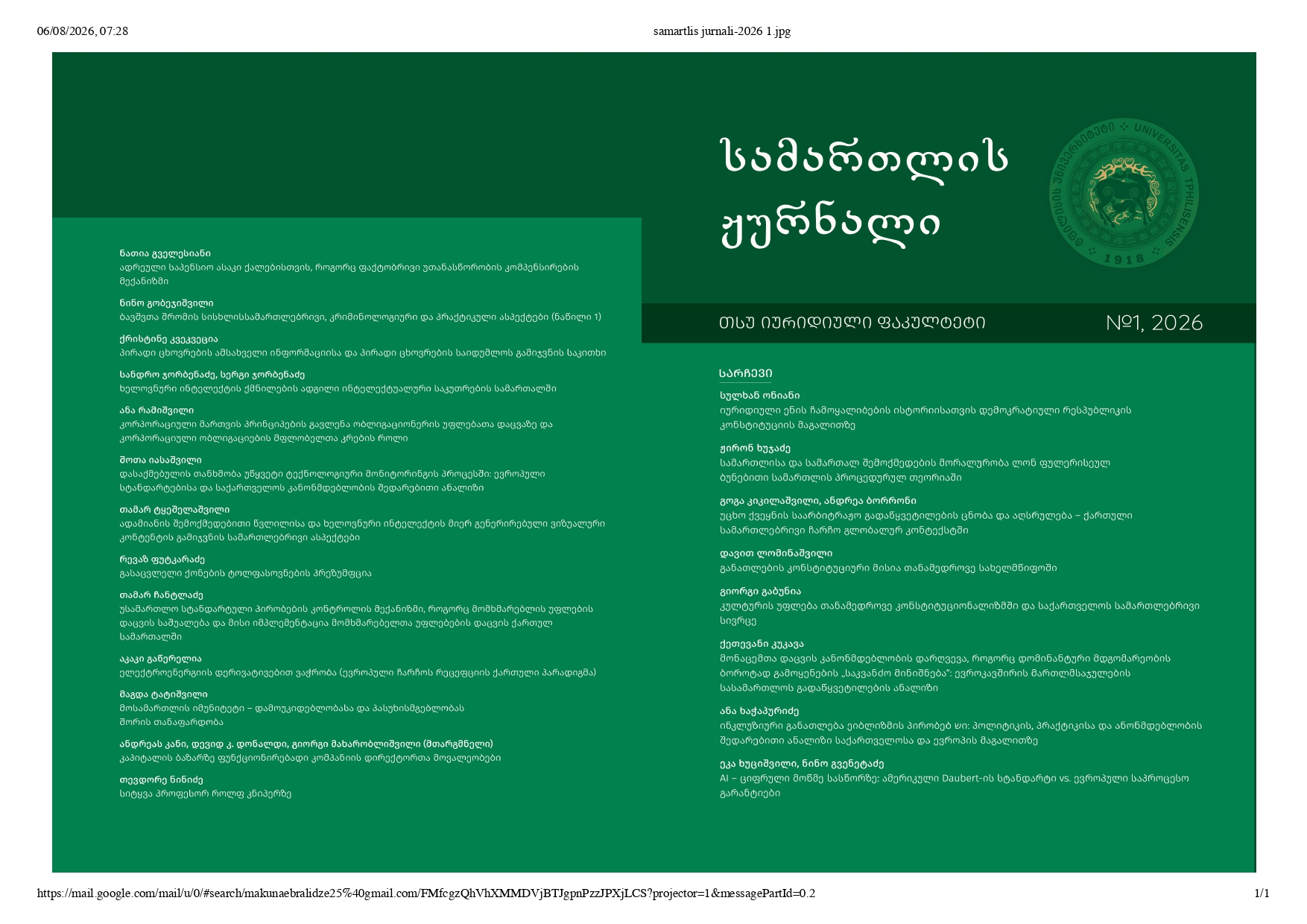
The Right to Culture in Modern Constitutionalism and Georgia’s Legal Framework
DOI:
https://doi.org/10.60131/jlaw.1.2026.11869Keywords:
right to culture, constitutionalism, human rights, cultural diversity, cultural heritage, Constitution of Georgia, UNESCO, cultural policy.Abstract
The present article examines the constitutional significance of the right to culture
in modern constitutionalism and its role in the development of a democratic state
governed by the rule of law and founded on social principles. The right to culture is
understood not merely as one of the fundamental human rights, but also as a
constitutional value that safeguards personal identity, dignity, freedom of self-
expression and the opportunity to participate fully in cultural life. The study is based on
an analysis of contemporary constitutional theory, international human rights law, the
European legal space and Georgia’s legal system.
Particular attention is devoted to the theoretical and legal foundations of the right
to culture, the State’s positive obligations concerning the protection and development of
cultural heritage, and the issues of ensuring cultural diversity, creative freedom and
equal access to cultural goods. The place of the right to culture within Georgia’s
constitutional order is also examined.
The study also focuses on the challenges of the contemporary era, including
problems concerning the protection and realisation of cultural rights in the context of
globalisation, digital transformation, cultural integration and technological progress. In
conclusion, it is argued that the right to culture constitutes one of the most important
constitutional foundations of the free development of the individual, the strengthening of
democratic culture, social integration, the protection of cultural diversity and the
sustainable development of the State, while its effective implementation within
Georgia’s legal framework constitutes an essential precondition for strengthening the
rule of law and democratic society.
References
Bibliography
1. Constitution of Georgia, Legislative Herald of Georgia, adopted on 24/08/1995.
2. Law of Georgia on Culture, Legislative Herald of Georgia, adopted on 22/06/1997.
3. Law of Georgia on Cultural Heritage, Legislative Herald of Georgia, adopted on
08/05/2007.
4. Law of Georgia on Copyright and Neighbouring Rights, Legislative Herald of
Georgia, adopted on 22/06/1999.
5. Universal Declaration of Human Rights, adopted 10/12/1948, United Nations
General Assembly Resolution 217 A (III).
6. International Covenant on Economic, Social and Cultural Rights, adopted
16/12/1966, entered into force 03/01/1976, 993 UNTS 3.
7. European Convention on Human Rights, adopted 04/11/1950, entered into force
03/09/1953.
8. UNESCO Convention Concerning the Protection of the World Cultural and Natural
Heritage, adopted 16/11/1972.
9. UNESCO Convention for the Safeguarding of the Intangible Cultural Heritage,
adopted 17/10/2003.
10. UNESCO Convention on the Protection and Promotion of the Diversity of Cultural
Expressions, adopted 20/10/2005.
11. UNESCO Universal Declaration on Cultural Diversity, adopted 02/11/2001.
12. Council of Europe, Cultural Rights in the Case-Law of the European Court of
Human Rights, Strasbourg, Council of Europe Publishing, 2011.
13. Donders Y., The Protection of Cultural Rights in International Law, The Hague,
Martinus Nijhoff Publishers, 2002.
14. Donnelly J., Universal Human Rights in Theory and Practice, 3 rd ed., Cornell
University Press, Ithaca 2013.
15. Geertz C., The Interpretation of Cultures, New York, Basic Books, 1973.
16. Häberle P., Verfassungslehre als Kulturwissenschaft, 2. stark erw. Aufl., Duncker &
Humblot, Berlin, 1998.
17. Shaheed F., Report of the Special Rapporteur in the Field of Cultural Rights, UN
Doc. A/HRC/14/36, United Nations, Geneva, 2010.
18. Judgment no. 2/1/536 of the Constitutional Court of Georgia of 4 February 2014.
19. Judgment no. 1/466 of the Constitutional Court of Georgia of 28 June 2010.
20. Chapman v. the United Kingdom [GC], application no. 27238/95, judgment of the
Grand Chamber of the European Court of Human Rights of 18 January 2001.
21. Cyprus v. Turkey [GC], application no. 25781/94, judgment of the Grand Chamber
of the European Court of Human Rights of 10 May 2001.
Published
How to Cite
Issue
Section
License

This work is licensed under a Creative Commons Attribution-ShareAlike 4.0 International License.