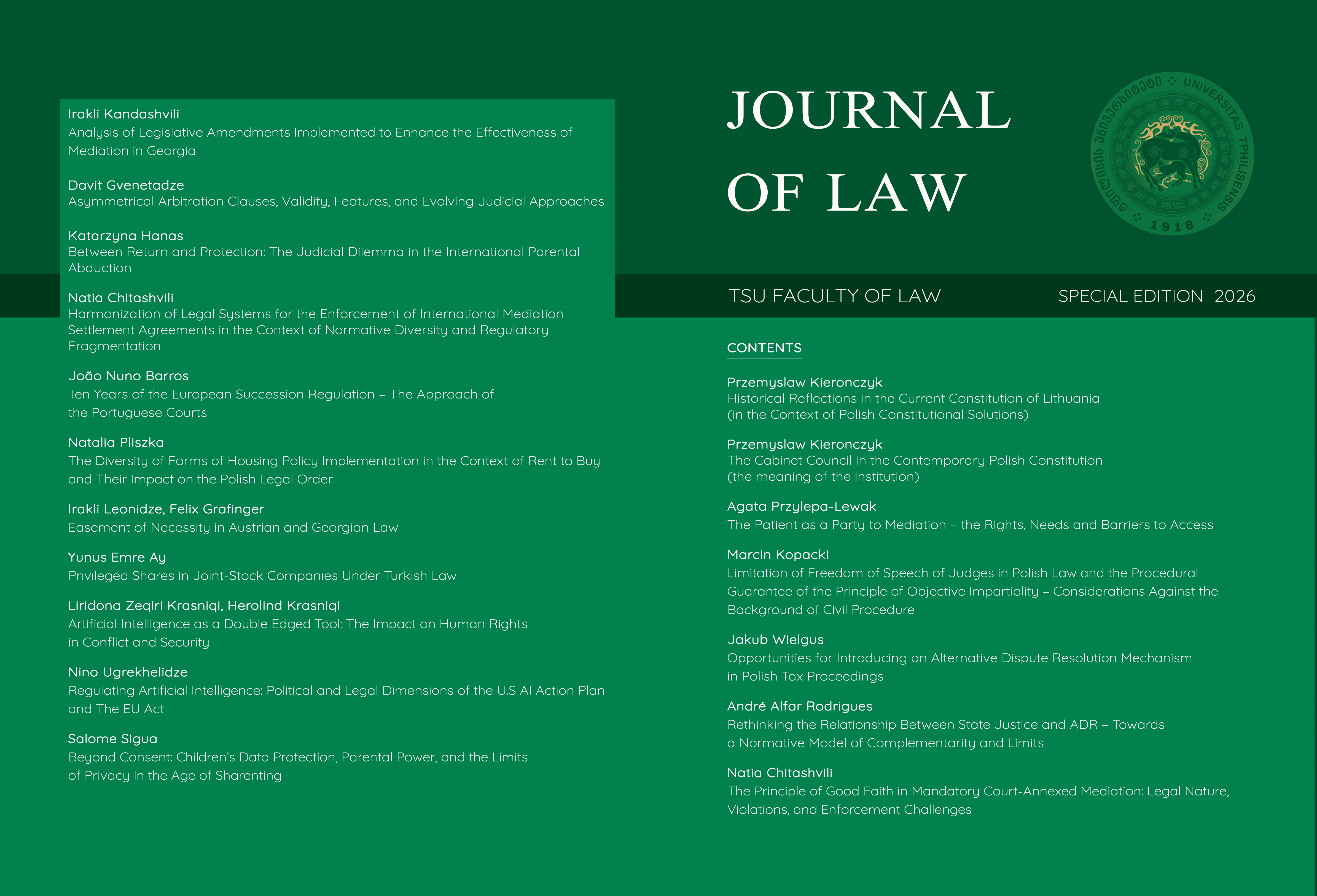
Between Return and Protection: The Judicial Dilemma in the International Parental Abduction
DOI:
https://doi.org/10.60131/jlaw.2.2026.11911Keywords:
parental abduction; child’s rights; protection of the child; welfare of the child; principle of law; general reference clause; Hague Convention.Abstract
The aim of the Convention on the Civil Aspects of International Child Abduction is to protect the welfare of the child and to make sure that the proceedings under the Convention are promptly carried out. At the heart of this issue lies the conflict between the wish to protect the welfare of the child and the legal, cultural and religious differences between the states involved in the dispute. The starting point for the discussion herein is the institution of parental responsibility and the right to a happy childhood. Both these components determine the proper understanding of the child’s welfare, which generally entails a return to the situation prior to the abduction. The criterion of the child’s welfare is an element of the principle of law and the general referring clause. It is a paramount value in family-law relations and takes precedence when resolving a conflict between the child’s interests and those of the parent. The parents are obliged to act in the interest of their child, and parental abduction contradicts this principle. A parent who acts contrary to a judicial decision or without the other parent’s consent is merely pursuing their own interests, which need not necessarily be regarded as consistent with the child’s welfare. It is certainly not an appropriate solution to suddenly change the place of residence or school of the minor, or to deprive them of contact with their peers or other family members. The person responsible for the harm caused to the child is the one who has a duty of care towards the child.
References
1. Convention on the Civil Aspects of International Child Abduction, UNTS, vol. 1343, 25/10/1980, 89.
2. Declaration of the Rights of the Child, adopted by the General Assembly of the League of Nations, 1924.
3. United Nations Convention on the Rights of the Child, UNTS, vol. 1577, 20/11/1989, 3.
4. Code of Civil Procedure of 17 November 1964, consolidated text: Journal of Laws of 2006, item 468, as amended.
5. Archard D., Children. Rights and Childhood, 3rd ed., New York, 1993.
6. Hanas K., Criterion "The Good of the Child" in the Legal Order. Between the Normative Structure and Judicial Case Law, Maribor, Institute for Local Self-Government Maribor, 2023.
7. Todd J. A., The Hague Convention on the Civil Aspects of International Child Abduction: Are the Convention's Goals Being Achieved?, Indiana Journal of Global Legal Studies, Vol. 2, Nr 2, 1995.
8. Białecki M., Analiza praw i obowiązków podmiotów uczestniczących w postępowaniu o nakazanie powrotu dziecka w ramach Konwencji haskiej o cywilnych aspektach uprowadzenia dziecka za granicę, „Polish-Italian Studies in Toruń", 2025.
9. Borysiak W., [in:] Safjan M., Bosek L. (eds.), Konstytucja RP, t. 1: Komentarz, art. 1–86, Warszawa, 2016.
10. Haak H., Władza rodzicielska. Komentarz, Toruń, 1995, 49.
11. Kordela M., Zasady prawa. Studium teoretycznoprawne, Poznań, Wydawnictwo Naukowe UAM, 2012.
12. Leszczyński L., O wykładni prawa i jej wymiarze praktycznym. Kontekst sądowego stosowania prawa, „Archiwum Filozofii Prawa i Filozofii Społecznej", Nr 2(23), 2020.
13. Leszczyński L., Tworzenie generalnych klauzul odsyłających, Lublin, Wydawnictwo UMCS, 2000.
14. Marciniak J., Treść i sprawowanie opieki nad małoletnim, Warszawa, 1975.
15. Stojanowska W., Dobro dziecka w aspekcie sprawowania nad nim władzy rodzicielskiej, „Studia nad Rodziną", Nr 4/1(6), 2000.
16. Wronkowska S., Zieliński M., Ziembiński Z., Zarys teorii prawa, Poznań, Przedsiębiorstwo Wydawnicze Ars Boni et Aequi, 1997.
17. Judgment of the Supreme Court of 22 January 2026, case ref. no. I CSK 3451/25, LEX No. 4016404.
18. Judgment of the Supreme Court of 8 July 2025, case ref. no. II CSKP 151/25, LEX No. 3914154.
19. Judgment of the Supreme Court of 16 May 2025, case ref. no. II CSKP 1209/24, LEX No. 3865262.
20. Judgment of the Supreme Court of 14 May 2025, case ref. no. II CSKP 1134/24, LEX No. 3865623.
21. Judgment of the Supreme Court of 18 July 2024, case ref. no. I CSK 2151/24, LEX No. 3738840.
22. Judgment of the Supreme Court of 12 April 2024, case ref. no. II CSKP 859/23, LEX No. 3703774.
23. Judgment of the Supreme Court of 28 February 2024, case ref. no. II NSNc 293/23, LEX No. 3690147.
24. Judgment of the Supreme Court of 25 April 2023, case ref. no. II CSKP 2340/22, LEX No. 3585398.
25. Judgment of the Supreme Court of 17 June 2021, case ref. no. I CSKP 360/21, LEX No. 3207947.
26. Carlson v. Switzerland, [2008] ECtHR, application No. 49492/06.
27. K.J. v. Poland, [2016] ECtHR, application No. 30813/14.
28. S. Povse and D. Povse v. Austria, [2013] ECtHR, application No. 3890/11.
29. X v. Latvia, [2013] ECtHR, application No. 27853/09.
Published
How to Cite
Issue
Section
License

This work is licensed under a Creative Commons Attribution-ShareAlike 4.0 International License.