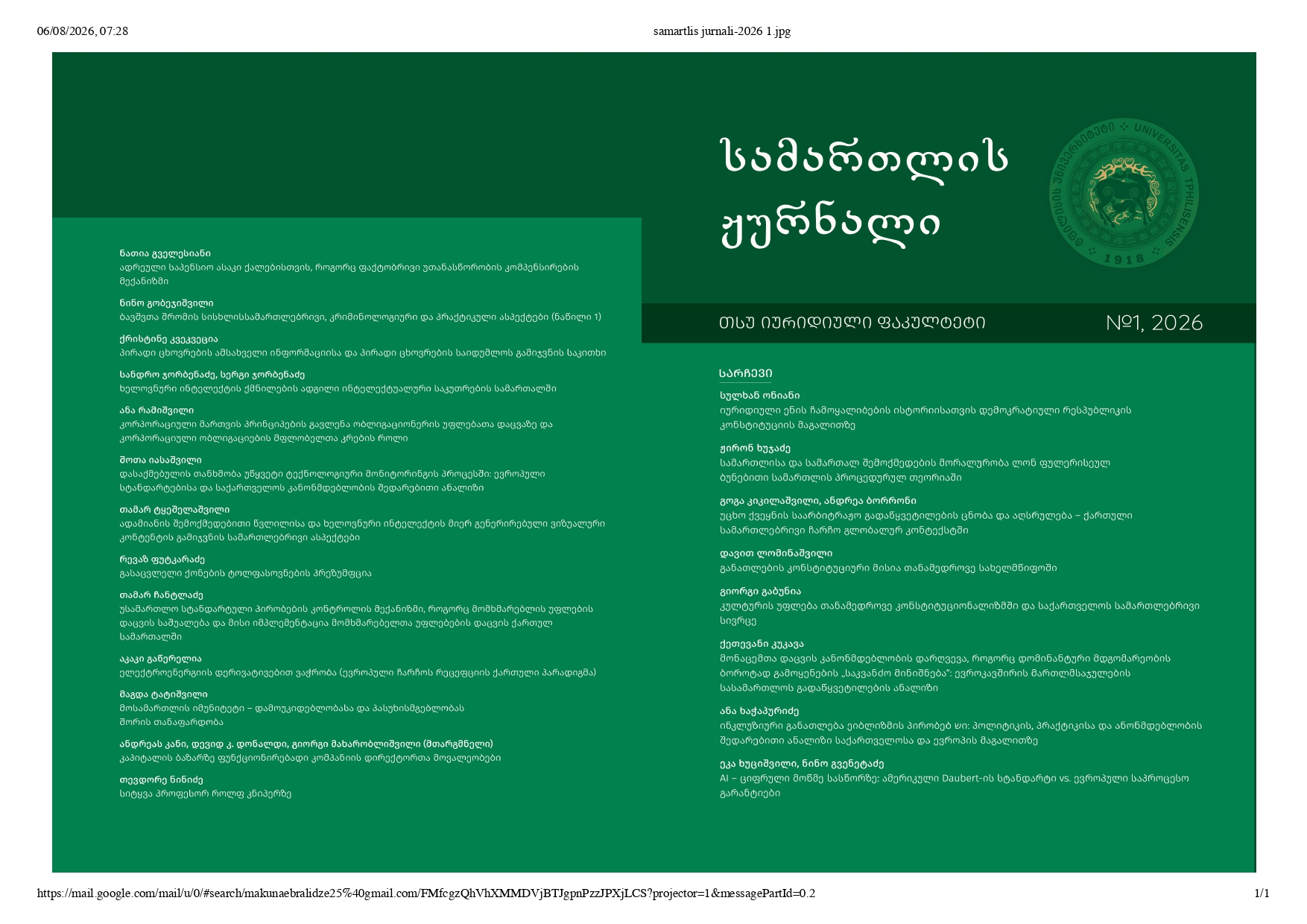
Trading in Electricity Derivatives (The Georgian Paradigm of the Reception of the European Framework)
DOI:
https://doi.org/10.60131/jlaw.1.2026.11890Keywords:
Georgian model of trading in electricity derivatives, electricity exchange, futures, forwards, options, swaps.Abstract
The article examines the legal mechanisms of wholesale trading in electricity derivatives and the relevant trading products on the basis of European experience. Within the framework of the research, the main types of electricity derivatives – futures, forwards, options and swaps – are discussed, including their legal nature, purposes of use and specific features of trading both on electricity exchanges and on over-the-counter and bilateral contract markets.
The article analyses European models for organising trading in electricity derivatives, including the role of exchanges, central counterparties, clearing and settlement mechanisms. Particular attention is paid to the use of derivatives in the context of managing risks associated with fluctuations in market prices and contractual relationships relating to future delivery.
A separate part of the research is devoted to the legal prerequisites for the functioning of the electricity derivatives market in Georgia. To this end, the relevant provisions of the Law of Georgia on Energy and Water Supply and the Law of Georgia on Financial Collateral Arrangements, Netting and Derivatives are examined. The paper raises the issue of the legal classification of electricity as an underlying asset of a derivative and assesses the possible role of the electricity exchange operator in the functioning of the derivatives market.
The research concludes that, for the development of the electricity derivatives market in Georgia, it is advisable to introduce appropriate legislative amendments and to share European experience with participants in the energy sector.
References
1. Scholer-Iordanashvili L., Derivatives and Financial Market Stability, doctoral dissertation, Grigol Robakidze University, Tbilisi, 2022 [in Georgian].
2. Fried J., Voelcker M., in: Pritzsche K., Vacha V. (Hrsg.), Energierecht, § 12 „Stromhandel“, München: C.H. Beck, 2024.
3. Lang W., Pritzsche H., Energierecht. Hrsg. von Bader, M. 2. Auflage. München: C.H. Beck, 2024.
4. Löschel A., Rübbelke D., Ströbele W., Pfaffenberger W., Heuterkes M., Energiewirtschaft. Einführung in Theorie und Politik. 4., vollständig überarbeitete Auflage. Berlin/Boston: Walter de Gruyter GmbH, 2020.
5. Mäntysaari P., EU Electricity Trade Law: The Legal Tools of Electricity Producers in the Internal Electricity Market. Cham: Springer International Publishing, 2015.
6. Meeus L., The Evolution of Electricity Markets in Europe. Cheltenham, UK / Northampton, MA, USA: Edward Elgar Publishing, 2020.
7. Moczko D. M., Mitteilungspflichten der Teilnehmer des Energiegroßhandelsmarktes nach dem europäischen Recht. Marktüberwachung auf Unionsebene und die Zusammenarbeit mit den nationalen Regulierungsbehörden. Inauguraldissertation zur Erlangung des Doktorgrades des Fachbereichs Rechtswissenschaft der Johann Wolfgang Goethe-Universität Frankfurt am Main. Frankfurt am Main, 2020.
8. Seeliger A., Seidel, M. (Hrsg.), Energiehandel – einfach erklärt. Strom, Erdgas, Wasserstoff, Berlin: VDE Verlag GmbH, 2025.
Published
How to Cite
Issue
Section
License

This work is licensed under a Creative Commons Attribution-ShareAlike 4.0 International License.