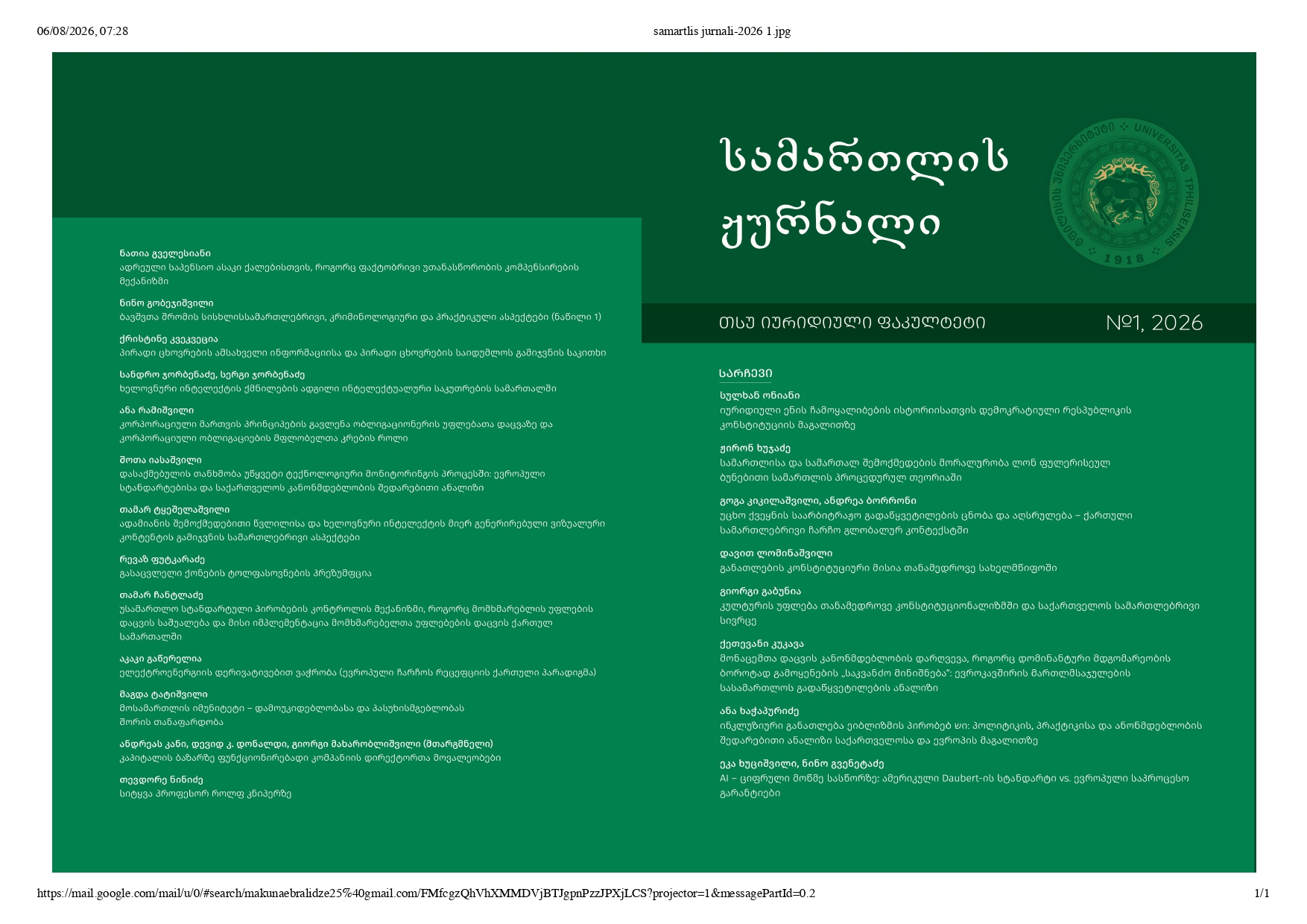
Employee Consent in the Process of Continuous Technological Monitoring: A Comparative Analysis of European Standards and Georgian Legislation
DOI:
https://doi.org/10.60131/jlaw.1.2026.11883Keywords:
Consent, Personal Data, Labor Law, UAM Monitoring, General Data Protection Regulation (hereafterAbstract
The present research is dedicated to a critical evaluation of the validity of employee consent as a legal basis for processing personal data under the conditions of continuous technological monitoring (hereafter "UAM") within the workplace. The starting point of the study is the structural power asymmetry inherent in employment relations, which essentially precludes the free expression of will and renders the institution of consent a legal fiction.
Based on a synthetic analysis of national labor and data protection legislation (the Labor Code of Georgia and the 2023 Law on "Personal Data Protection"), alongside the case law of the European Court of Human Rights (Bărbulescu v. Romania, 2017; López Ribalda v. Spain, 2019) and the Court of Justice of the European Union (hereafter "CJEU", Case C-34/21), the paper establishes that consent alone is insufficient to legitimize digital surveillance. Emphasis is placed on the necessity of relying upon alternative mechanisms—namely, the three-step legitimate interests assessment (hereafter "LIA"), the proportionality test, and the mandatory data protection impact assessment (hereafter "DPIA").
Additionally, the paper analyzes the institutional transformation enacted as of March 2, 2026 - specifically, the transfer of the supervisory mandate to the State Audit Office - as a novel practical challenge in the process of enforcing and administering heightened data protection standards within employment relations.
References
1. Law of Georgia "On Personal Data Protection", June 14, 2023 (including the amendments of December 17, 2025); Organic Law of Georgia "Labor Code of Georgia", December 17, 2010 (consolidated version) (in Georgian).
2. Regulation (EU) 2016/679 of the European Parliament and of the Council of 27 April 2016 on the Protection of Natural Persons With Regard to the Processing of Personal Data and on the Free Movement of Such Data (General Data Protection Regulation ― GDPR), 2016.
3. Personal Data Protection Service, Guiding Recommendations for Small and Medium-Sized Enterprises, 2024 (in Georgian).
4. Shvelidze Z., "Characteristics of the Legal Status of an Employee under the Labor Code of Georgia", Labor Law, Collection of Articles I, ed. Zaalishvili V., Tbilisi, 2011, pp. 56-60 (in Georgian).
5. European Data Protection Board (EDPB), Guidelines 05/2020 on Consent Under Regulation 2016/679, 2020.
6. European Data Protection Board (EDPB), Guidelines 2/2019 on the Processing of Personal Data Under Article 6(1)(b) GDPR in the Context of the Provision of Online Services to Data Subjects, 2019.
7. Aloisi A., Gramano E., "Artificial Intelligence Is Watching You at Work: Digital Surveillance, Employee Monitoring, and Regulatory Issues in the EU Context", Comparative Labor Law & Policy Journal, 2019, 95, 104.
8. Armaroli I., Dagnino E., "A Seat at the Table: Negotiating Data Processing in the Workplace", Comparative Labor Law & Policy Journal, 2019, 36.
9. De Stefano V., "Negotiating the Algorithm: Automation, Artificial Intelligence, and Labor Protection", Comparative Labor Law & Policy Journal, 2019, 15, 19.
10. Eurofound, "Employee Monitoring: A Moving Target for Regulation", European Restructuring Monitor (ERM) Database, 2023, 95, 104.
11. Hendrickx F., Employment Privacy Law in the European Union: Surveillance and Monitoring, Antwerp-Oxford-New York, 2002, 45-47.
12. Hendrickx F., Privacy and Data Protection in the Workplace, 2022.
13. Kuner C., Bygrave L. A., Docksey C. (eds.), The EU General Data Protection Regulation (GDPR): A Commentary, Oxford University Press, 2020, 1234, 1237.
14. Decision of the Civil Affairs Chamber of the Supreme Court of Georgia of April 18, 2018, Case No. as-142-134-2017 (in Georgian).
15. Decision of the Civil Affairs Chamber of the Supreme Court of Georgia of September 29, 2017, Case No. as-247-235-2017 (in Georgian).
16. Ruling of the Civil Affairs Chamber of the Supreme Court of Georgia of April 28, 2010, Case No. as-864-1150-09 (in Georgian).
17. Hauptpersonalrat der Lehrerinnen und Lehrer beim Hessischen Kultusministerium, Case C-34/21, Court of Justice of the European Union (CJEU), 30 March 2023.
18. López Ribalda and Others v. Spain [GC], App. Nos. 1874/13 and 8567/13, European Court of Human Rights, 17 October 2019.
19. Bărbulescu v. Romania [GC], App. No. 61496/08, European Court of Human Rights, 5 September 2017.
20. Payne v. Western & Atlantic Railroad Co., 81 Tenn. 507, Supreme Court of Tennessee, 1884.
Published
How to Cite
Issue
Section
License

This work is licensed under a Creative Commons Attribution-ShareAlike 4.0 International License.