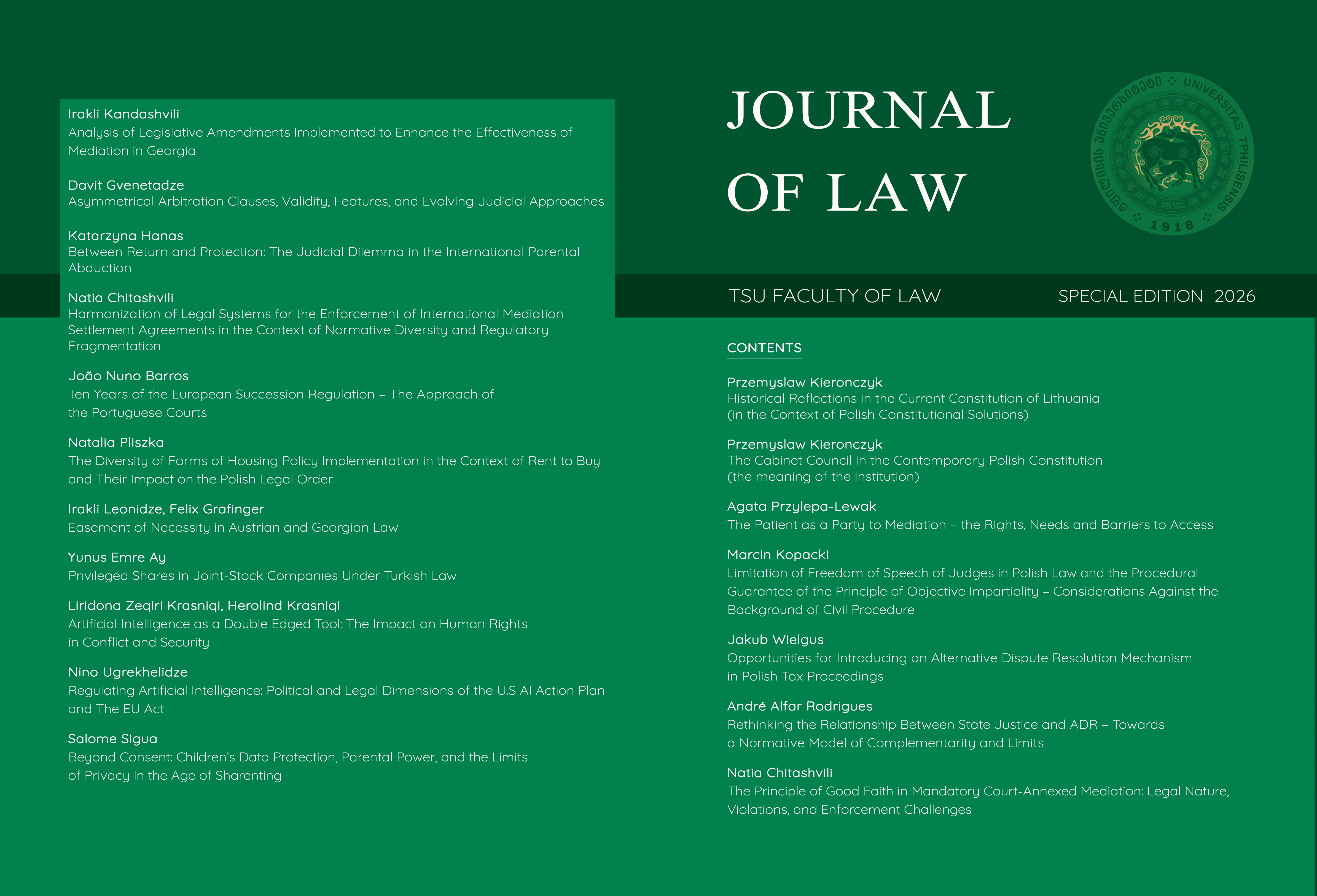
Rethinking the Relationship Between State Justice and ADR – Towards a Normative Model of Complementarity and Limits
DOI:
https://doi.org/10.60131/jlaw.2.2026.11908Keywords:
Alternative Dispute Resolution, State Justice, Complementarity, Judicial Oversight, Access to Justice, Procedural Justice.Abstract
This article reconsiders the relationship between state justice and alternative dispute resolution from a normative rather than merely functional perspective. It argues that courts and ADR should not be understood as rival systems competing for institutional supremacy, but as differentiated mechanisms whose legitimacy depends on a structured model of complementarity. Such complementarity is justified where ADR improves accessibility, procedural economy, expertise, or consensual problem-solving in ways that judicial adjudication does not always achieve with the same adequacy. At the same time, the legitimacy of ADR remains conditional. It is limited by requirements of procedural fairness, the protection of weaker parties, the non-privatisable character of certain disputes, and the continuing responsibility of the state to secure effective legal protection. The article therefore contends that ADR is not legitimate by virtue of efficiency alone. Its legitimacy depends on its integration within a broader framework of public justice and judicial oversight.
References
1. Convention on the Recognition and Enforcement of Foreign Arbitral Awards, adopted on 10 June 1958.
2. Directive 2008/52/EC of the European Parliament and of the Council of 21 May 2008 on Certain Aspects of Mediation in Civil and Commercial Matters, OJ L 136, 24/05/2008.
3. Directive 2013/11/EU of the European Parliament and of the Council of 21 May 2013 on Alternative Dispute Resolution for Consumer Disputes and Amending Regulation (EC) No 2006/2004 and Directive 2009/22/EC, OJ L 165, 18/06/2013.
4. UNCITRAL Model Law on International Commercial Arbitration, adopted on 21 June 1985, as amended on 7 July 2006.
5. Constituição da República Portuguesa, aprovada em 2 de abril de 1976.
6. Decreto-Lei n.º 10/2011, de 20 de janeiro.
7. Lei n.º 63/2011, de 14 de dezembro.
8. Lei n.º 29/2013, de 19 de abril.
9. Lei n.º 78/2001, de 13 de julho.
10. Lei n.º 144/2015, de 8 de setembro.
11. Portaria n.º 112-A/2011, de 22 de março.
12. Cappelletti M., Garth B. G., Access to Justice: The Newest Wave in the Worldwide Movement to Make Rights Effective, Buffalo Law Review, Vol. 27, 1978.
13. Cortés P., The Law of Consumer Redress in an Evolving Digital Market, Cambridge, Cambridge University Press, 2018.
14. Fiss O. M., Against Settlement, Yale Law Journal, Vol. 93, 1984.
15. Galanter M., The Vanishing Trial: An Examination of Trials and Related Matters in Federal and State Courts, Journal of Empirical Legal Studies, Vol. 1, Issue 3, 2004.
16. Genn H., Judging Civil Justice, Cambridge, Cambridge University Press, 2010.
17. Genn H., What Is Civil Justice For? Reform, ADR, and Access to Justice, Yale Journal of Law and the Humanities, Vol. 24, No. 1, 2012.
18. Härter K., Hillemanns C., Schlee G., Introduction, in: Härter K., Hillemanns C., Schlee G. (eds.), On Mediation: Historical, Legal, Anthropological and International Perspectives, New York, Oxford, Berghahn Books, 2020.
19. Hopt K. J., Steffek F. (eds.), Mediation: Principles and Regulation in Comparative Perspective, Oxford, Oxford University Press, 2013.
20. McGregor L., Alternative Dispute Resolution and Human Rights: Developing a Rights-Based Approach through the ECHR, European Journal of International Law, Vol. 26, No. 3, 2015.
21. Menkel-Meadow C., Whose Dispute Is It Anyway? A Philosophical and Democratic Defense of Settlement (In Some Cases), Georgetown Law Journal, Vol. 83, 1995.
22. Resnik J., Managerial Judges, Harvard Law Review, Vol. 96, 1982.
23. Sternlight J. R., Panacea or Corporate Tool?: Debunking the Supreme Court’s Preference for Binding Arbitration, Washington University Law Review, Vol. 74, Issue 3, 1996.
24. Tyler T. R., What Is Procedural Justice? Criteria Used by Citizens to Assess the Fairness of Legal Procedures, Law and Society Review, Vol. 22, No. 1, 1988.
25. Tyler T. R., Procedural Justice, Legitimacy, and the Effective Rule of Law, Crime and Justice, Vol. 30, 2003.
26. Welsh N. A., Making Deals in Court-Connected Mediation: What’s Justice Got to Do With It?, Washington University Law Quarterly, Vol. 79, No. 3, 2001.
27. Welsh N. A., The Place of Court-Connected Mediation in a Democratic Justice System, Cardozo Journal of Conflict Resolution, Vol. 5, No. 2, 2004.
28. Yeazell S. C., The Misunderstood Consequences of Modern Civil Process, Wisconsin Law Review, 1994.
29. Case C-75/16, Menini and Rampanelli, Judgment of 14/06/2017.
30. Joined Cases C-317/08 to C-320/08, Alassini and Others, Judgment of 18/03/2010.
31. Case C-40/08, Asturcom Telecomunicaciones, Judgment of 06/10/2009.
32. Case C-168/05, Mostaza Claro, Judgment of 26/10/2006.
33. Case C-126/97, Eco Swiss China Time Ltd v Benetton International NV, Judgment of 01/06/1999.
34. Suovaniemi and Others v. Finland, Decision on Admissibility, Application No. 31737/96, 23/02/1999.
35. Deweer v. Belgium, [1980] ECHR.
Published
How to Cite
Issue
Section
License

This work is licensed under a Creative Commons Attribution-ShareAlike 4.0 International License.