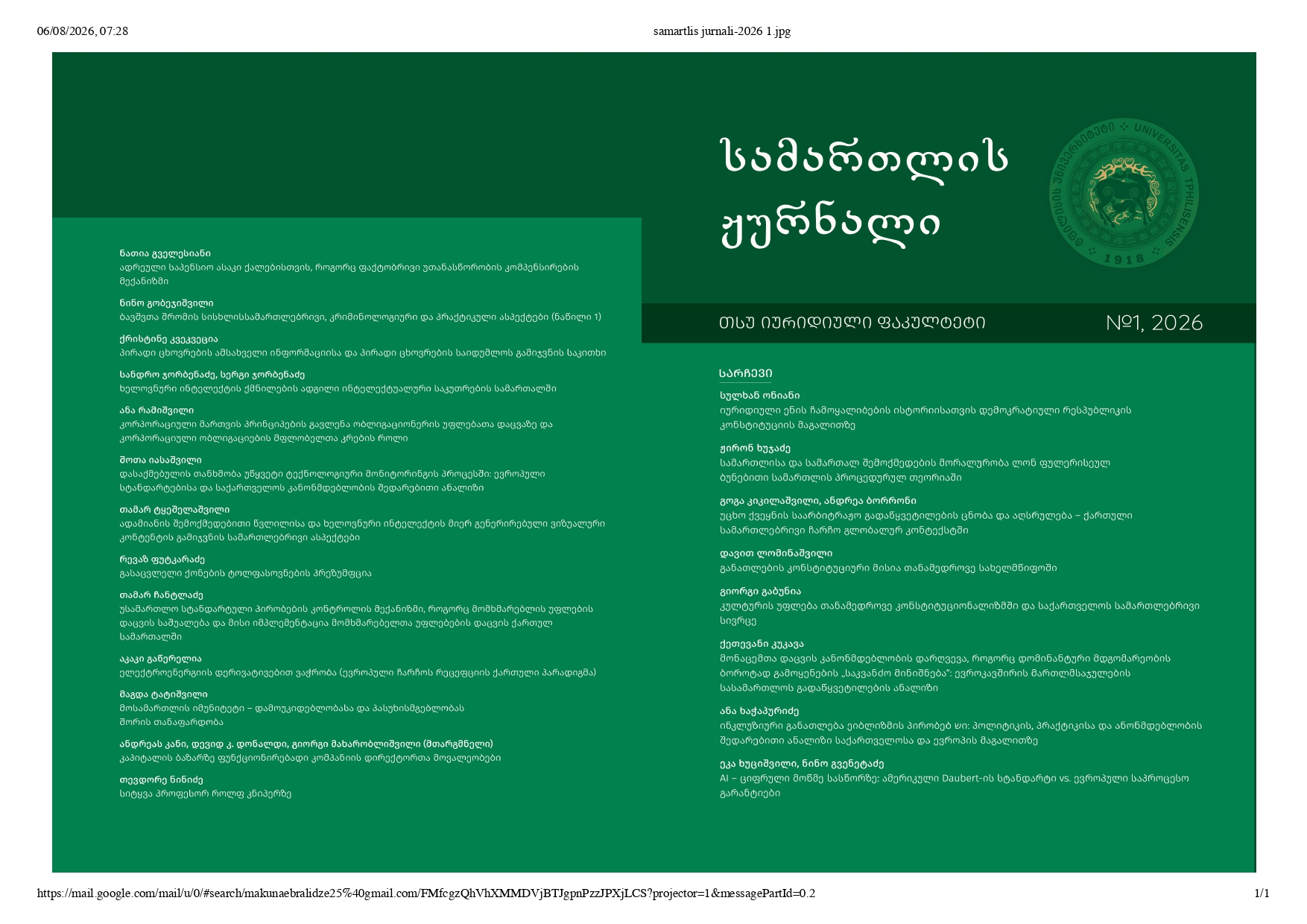
Legal Aspects of Distinguishing Human Creative Contribution from Visual Content Generated by Artificial Intelligence
DOI:
https://doi.org/10.60131/jlaw.1.2026.11884Keywords:
artificial intelligence; visual content; copyright; creative contribution; originality.Abstract
The article aims to analyse the legal distinction between human creative contribution and visual content generated by artificial intelligence, and to identify possible directions for the development of copyright law in the context of the growing relevance of generative artificial intelligence. The research is based on scholarly, comparative and doctrinal analysis, as well as historical and contemporary approaches, enabling an assessment of both the existing legal framework and the need for its adaptation.
The article demonstrates the impact of the development of generative artificial intelligence on creative activity and its legal consequences. Modern AI systems generate visual content through algorithmic processes, making it difficult to distinguish between human involvement and that of the so-called “machine” in the creative process.
The present article examines the function, significance and capabilities of artificial intelligence and their impact on copyright. On the basis of an analysis of international practice and the risks identified, the article advances the view that the legal system should adapt to technological developments and introduce more flexible, hybrid models that both recognise human creative contribution and take account of the role of AI as a tool. The novelty of the research developed in the article lies in the formulation of a balanced model based on contemporary judicial practice and international approaches.
References
1. Law of Georgia on Copyright and Related Rights, Legislative Herald of Georgia, 08/07/1999, <https://matsne.gov.ge/ka/document/view/16198?publication=18> [28.03.2026].
2. UK Copyright, Designs and Patents Act, <https://www.legislation.gov.uk/ukpga/1988/48/contents> [28.03.2026].
3. German Copyright Act, 23.10.2024, <https://www.gesetze-im-internet.de/englisch_urhg/englisch_urhg.html> [28.03.2026].
4. Copyright Law of the United States, 2025, <https://www.copyright.gov/title17/> [28.03.2026].
5. Directive 2009/24/EC of the European Parliament and of the Council of 23 April 2009 on the Legal Protection of Computer Programs (Codified Version) (Text with EEA relevance), <https://eur-lex.europa.eu/eli/dir/2009/24/oj> [28.03.2026].
6. Council of Europe Framework Convention on Artificial Intelligence and Human Rights, Democracy and the Rule of Law, adopted on 17.05.2024, opened for signature on 05.09.2024, not yet in force, <https://www.coe.int/en/web/artificial-intelligence/the-framework-convention-on-artificial-intelligence> [28.03.2026].
7. French Intellectual Property Code, 1992, <https://www.unodc.org/cld/document/fra/1992/intellectual_property_code.html?> [28.03.2026].
8. The Intellectual Property Act, 1996, <https://www.mjusticia.gob.es/es/AreaTematica/DocumentacionPublicaciones/Documents/The_Intellectual_Property_Act_%28Ley_de_Propiedad_Intelectual%29.PDF> [28.03.2026].
9. U.S. Copyright Office, Copyright Registration Guidance: Works Containing Material Generated by Artificial Intelligence, 16.03.2023, <https://www.federalregister.gov/documents/2023/03/16/2023-05321/copyright-registration-guidance-works-containing-material-generated-by-artificial-intelligence#citation-19-p16192> [28.03.2026].
10. Analla T., Zarya of the Dawn: How AI is Changing the Landscape of Copyright Protection, Harvard Journal of Law & Technology (JOLT), 06/03/2023, <https://jolt.law.harvard.edu/digest/zarya-of-the-dawn-how-ai-is-changing-the-landscape-of-copyright-protection> [28.03.2026].
11. Barbashyn S., Sui Generis: How AI-generated Works are Protected in Ukraine and Beyond, AIPPI, 2025, <https://www.aippi.org/news/sui-generis-how-ai-generated-works-are-protected-in-ukraine-and-beyond/> [28.03.2026].
12. Campbell Ch., The Next Rembrandt: Originality and Authorship of AI Generated Works, <https://journals.library.columbia.edu/index.php/stlr/blog/view/176> [28.03.2026].
13. Frosio G., Generative AI in Court, Recreating Creativity, Reinventing Inventiveness: Challenges Facing Intellectual Property Law, Koutras N., Selvadurai N. (eds.), Routledge, New York, 2024, <https://www.slideshare.net/slideshow/recreating-creativity-reinventing-inventiveness-challenges-facing-intellectual-property-law-nikos-koutras-and-niloufer-selvadurai/279521731#49> [28.03.2026].
14. Feuerriegel S., Hartmann J., Janiesch C. Zschech P., Generative AI, Business & Information Systems Engineering (BISE), Springer (eds.), 66(1), 2024, <https://www.researchgate.net/publication/370965310_Generative_AI> [28.03.2026].
15. Hutson J., The Evolving Role of Copyright Law in the Age of AI-Generated Works, Journal of Digital Technologies and Law, Kazan Innovative University named after V. G. Timiryasov, Vol. 2, No. 4, 2024, <https://www.lawjournal.digital/jour/article/view/486/198> [28.03.2026].
16. Hartmann J., Exner Y., Domdey S., The Power of Generative Marketing: Can Generative AI Create Superhuman Visual Marketing Content? International Journal of Research in Marketing, Vol. 42, Issue 1, 2025, <https://www.sciencedirect.com/science/article/pii/S0167811624000843> [28.03.2026].
17. Hugenholtz P B., Quintais J P., Gervais D., Trends and Developments in Artificial Intelligence: Challenges to the Intellectual Property Rights Framework, European Commission, 2020, <https://www.ivir.nl/publicaties/download/Trends_and_Developments_in_Artificial_Intelligence.pdf> [28.03.2026].
18. Kasap A., Copyright and Creative Artificial Intelligence (AI) Systems: A Twenty-first Century Approach to Authorship of AI-Generated Works in the United States, Wake Forest Journal of Business and Intellectual Property Law (eds.), Vol. 19, No. 4, 2019, <https://osf.io/preprints/socarxiv/gnyha_v1> [28.03.2026].
19. Li Y., The Human Authorship Requirement in AI-Generated Works: A Comparative Analysis of Copyright Protection Frameworks, Journal of Law and Governance, Vol. 1, No. 1, 2025, <https://jlg.cultechpub.com/index.php/jlg/issue/view/1> [28.03.2026].
20. Schor Z., Andersen v. Stability AI: The Landmark Case Unpacking the Copyright Risks of AI Image Generators, NYU Law, 02.12.2024, <https://jipel.law.nyu.edu/andersen-v-stability-ai-the-landmark-case-unpacking-the-copyright-risks-of-ai-image-generators/> [28/03/2026].
21. Thambaiya N., Kariyawasam K., Talagala C., Copyright Law in the Age of AI: Analysing the AI-generated Works and Copyright Challenges in Australia, International Review of Law, Computers & Technology, Routledge Taylor & Francis Group, 39(3), London, 2025, <https://www.tandfonline.com/doi/epdf/10.1080/13600869.2025.2486893?needAccess=true> [28.03.2026].
22. Zhou E., Lee D., Generative artificial intelligence, human creativity, and art, PNAS Nexus, Vol. 3, Issue 3, 2024, <https://academic.oup.com/pnasnexus/article/3/3/pgae052/7618478> [28.03.2026].
23. Zurth P., Artificial Creativity? A Case against Copyright Protection for AI-Generated Works, UCLA Journal of Law and Technology 25, No. 2, 2021, <https://uclajolt.com/artificial-creativity-a-case-against-copyright-protection-for-ai-generated-works/> [28.03.2026].
24. Burrow-Giles Lithographic Company v. Sarony, 1884, 111 U.S. 59, <https://supreme.justia.com/cases/federal/us/111/53/> [28.03.2026].
25. Feist Publications, Inc. v. Rural Telephone Service Company, Inc., (1991), 499 U.S. 346, <https://supreme.justia.com/cases/federal/us/499/340/> [28.03.2026].
26. Eva-Maria Painer v. Standard VerlagsGmbH and Others, [2011] EUR-Lex, § 99, the Court of Justice of the European Union (CJEU), <https://eur-lex.europa.eu/legal-content/EN/TXT/?uri=celex:62010CJ0145> [28.03.2026].
27. Andersen S., et al., v. Stability AI LTD., et al., (2024), United States District Court, Northern District of California, <https://law.justia.com/cases/federal/district-courts/california/candce/3:2023cv00201/407208/166/> [28.03.2026].
Published
How to Cite
Issue
Section
License

This work is licensed under a Creative Commons Attribution-ShareAlike 4.0 International License.