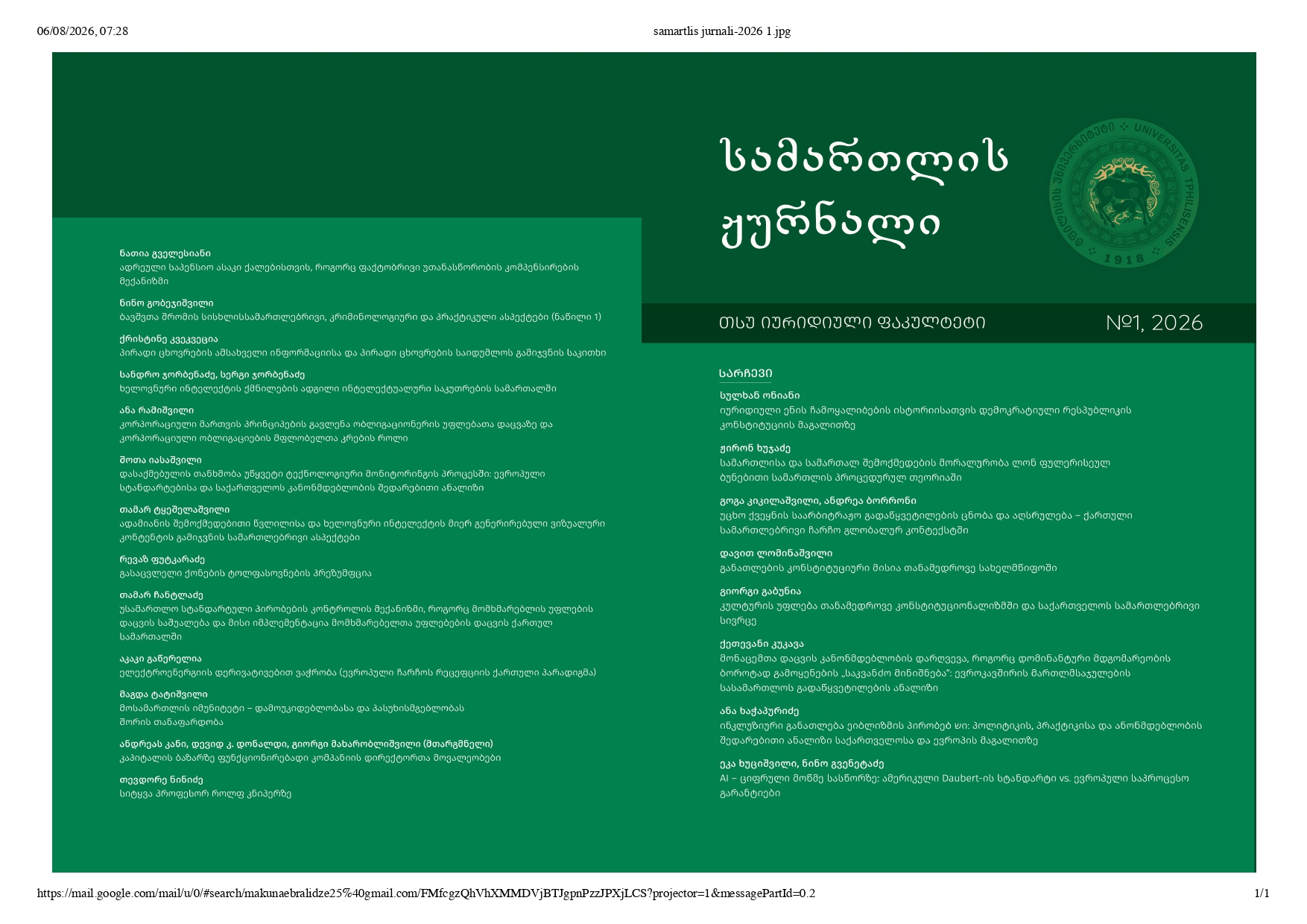
AI - A Digital Witness on the Scales: The American Daubert Standard vs. European Procedural Guarantees
DOI:
https://doi.org/10.60131/jlaw.1.2026.11873Keywords:
Artificial Intelligence, Fair Trial, Daubert Standard, Algorithmic Bias, Black Box, Adversariality, Raw Data.Abstract
The article examines the complex challenges associated with the integration of Artificial Intelligence (AI) into criminal proceedings within the context of the right to a fair trial (ECHR, Article 6). The purpose of this paper is to evaluate the admissibility and reliability of AI-generated evidence, based on a comparative analysis of American (Frye/Daubert) and European (jurisprudence of the European Court of Human Rights) legal filters.
Within the scope of the research, the differentiated model of "device evidence" and the so-called "black box" problem are analyzed, both of which create informational asymmetry between the parties and jeopardize the principle of "equality of arms." The article also addresses the phenomenon of "function creep" and algorithmic bias, which frequently lead to violations of fundamental human rights.
The paper substantiates that in the digital era, a fair trial requires a transition from formal to functional adversariality. The author proposes a three-component model of evidence validation (comprising technological, methodological, and applied levels) along with innovative legal mechanisms such as: the right to raw data; algorithmic counter-intelligence (Artificial Counter-Intelligence); and the mandatory application of the "human-in-the-loop" principle.
The concluding section of the article emphasizes the crucial role of the judge as a technological "gatekeeper." The paper argues that technological efficiency cannot replace individual judicial discretion, and any algorithmic conclusion must be subjected to strict standards of transparency and contestability.
References
1. Resolution No. 100 of the Government of Georgia, dated April 3, 2025 (in Georgian).
2. Order No. 21 of the Head of the Personal Data Protection Service of Georgia, dated February 28, 2024 (in Georgian).
3. Law of Georgia "On Personal Data Protection", dated June 14, 2023 (in Georgian).
4. Order No. 151/04 of the President of the National Bank of Georgia, dated August 17, 2020 (in Georgian).
5. Criminal Procedure Code of Georgia, No. 1772, dated October 9, 2009 (in Georgian).
6. Constitution of Georgia, No. 786, dated August 24, 1995 (in Georgian).
7. Executive Order 14110, Safe, Secure, and Trustworthy Development and Use of Artificial Intelligence (USA, 30 October 2023), 88 Fed Reg 75191.
8. US Federal Rules of Criminal Procedure, Rule 16.
9. US Federal Rules of Evidence, Rule 702.
10. US Federal Rules of Evidence, Rule 403.
11. Directive (EU) 2024/2853 of the European Parliament and of the Council of 23 October 2024 on liability for defective products [2024] OJ L 2024/2853.
12. Regulation (EU) 2024/1689 of the European Parliament and of the Council (Artificial Intelligence Act) [2024] OJ L 2024/1689.
13. Council of Europe Framework Convention on Artificial Intelligence and Human Rights, Democracy and the Rule of Law (17 May 2024) Council of Europe Treaty Series No 225.
14. UNGA Res 78/265 ‘Seizing the opportunities of safe, secure and trustworthy artificial intelligence systems for sustainable development’ (21 March 2024) UN Doc A/RES/78/265.
15. Regulation (EU) 2019/2144 of the European Parliament and of the Council on type-approval requirements for motor vehicles [2019] OJ L 325/1.
16. Directive (EU) 2016/680 of the European Parliament and of the Council of 27 April 2016 on the protection of natural persons with regard to the processing of personal data by competent authorities [2016] OJ L 119/89.
17. Regulation (EU) 2016/679 of the European Parliament and of the Council (General Data Protection Regulation) [2016] OJ L 119/1.
18. International Covenant on Civil and Political Rights (adopted 16 December 1966) 999 UNTS 171.
19. Convention for the Protection of Human Rights and Fundamental Freedoms (European Convention on Human Rights, as amended) (ECHR).
20. UNGA, ‘Universal Declaration of Human Rights’ (10 December 1948) 217 A (III).
21. Krpelík v Czech Republic App no 23963/21 (ECtHR, 12 June 2025).
22. Johnson v State No 413, Sept Term 2023 (Md App Ct, 6 August 2024).
23. Podchasov v Russia App no 33696/19 (ECtHR, 2024).
24. State of Minnesota v Gerald Paul Archambault No 62-CR-20-5866 (2024).
25. State of Washington v Puloka No 21-1-04851-2 KNT (2024).
26. Wałęsa v Poland App no 50849/21 (ECtHR, 23 November 2023).
27. Glukhin v Russia App no 11519/20 (ECtHR, 2023).
28. Mata v Avianca, Inc (2023) 678 F Supp 3d 443 (SDNY).
29. Reyes v State (2023) 257 Md App 596.
30. State v Arteaga 476 NJ Super 36 (App Div 2023).
31. People v Wakefield [2022] NY Slip Op 02771.
32. NJCM and others v The Netherlands [2020] ECLI:NL:RBDHA:2020:1878 (District Court of The Hague) [SyRI Case].
33. United States v Curry 965 F3d 313 (4th Cir 2020).
34. State v Loomis 881 NW 2d 749 (Wis 2016).
35. Daubert v Merrell Dow Pharmaceuticals, Inc 509 US 579 (1993).
36. Brady v Maryland 373 US 83 (1963).
37. Frye v United States 293 F 1013 (DC Cir 1923).
38. Al-Khawaja and Tahery v United Kingdom App nos 26766/05 and 22228/06 (ECtHR, 15 December 2011).
39. Artigot i Golobardes M and others (eds), Artificial Intelligence, Judicial Decision-Making and Fundamental Rights: JuLIA Handbook (2nd edn, Scuola Superiore della Magistratura 2024).
40. Citron DK, ‘Technological Due Process’ (2008) 85 Washington University Law Review 1249.
41. Eubanks V, Automating Inequality (St Martin's Press 2018).
42. Feigenson N and Carney B, ‘Generative AI as Courtroom Evidence: A Practical Guide’ (2024) 50 Mitchell Hamline Law Review 246.
43. Floridi L and Cowls J, ‘A Unified Framework of Five Principles for AI in Society’ (2019) 31(4) Harvard Data Science Review.
44. Garrett BL and Rudin C, ‘The Problem of Digital Evidence’ (2024) 172 University of Pennsylvania Law Review 343.
45. Gless S and others, ‘AI-Based Evidence in Criminal Trials?’ (2024) 59 Tulsa Law Review 1.
46. Grimm PW and others, ‘Artificial Intelligence as Evidence’ (2021) 19 Northwestern Journal of Technology and Intellectual Property 9.
47. Kaminski ME and Urban JM, ‘The Right to Contest AI’ (2021) 121 Columbia Law Review 1957.
48. Pasquale F, The Black Box Society (Harvard University Press 2015).
49. Princes E and others, ‘The Concept of Justice in AI-Driven Legal Decision Making’ (2025) 8(1) bit-Tech 78.
50. Rawls J, A Theory of Justice (rev edn, Harvard University Press 1999).
51. Richardson R and others, ‘Dirty Data, Bad Predictions’ (2019) 94 New York University Law Review Online 15.
52. CDDH-IA, [Draft] Handbook on Human Rights and Artificial Intelligence (Council of Europe 2025).
53. CEPEJ, European Ethical Charter on the Use of Artificial Intelligence in Judicial Systems (Council of Europe 2018).
54. European Commission, White Paper on Artificial Intelligence (COM(2020) 65 final).
55. High-Level Expert Group on AI, Ethics Guidelines for Trustworthy AI (European Commission 2019).
56. OECD, Recommendation of the Council on Artificial Intelligence (OECD/LEGAL/0449, 2019).
57. Public Defender of Georgia, Report on the Situation of Protection of Human Rights and Freedoms in Georgia - 2024 (Tbilisi 2025).
58. White House, Blueprint for an AI Bill of Rights (2023).
59. Angwin J and others, ‘Machine Bias’ (ProPublica, 23 May 2016) <https://www.propublica.org/article/machine-bias-risk-assessments-in-criminal-sentencing> [06.06.2026].
60. Emteria, ‘What Is Firmware? A Comprehensive Guide’ <https://emteria.com/learn/firmware> [06.06.2026].
61. Oracle, ‘What Is IoT?’ <https://www.oracle.com/internet-of-things/#why-is-iot-important> [06.06.2026].
62. Public Justice, ‘Failing to Disclose Use of Facial Recognition Technology in Criminal Cases Deprives Defendants of a Fair Trial’ (8 August 2024) <https://www.publicjustice.org/en/news/failing-to-disclose-use-of-facial-recognition-technology-in-criminal-cases-deprives-defendants-of-a-fair-trial-appellate-court-of-maryland-rules/> [06.06.2026].
63. Wenar L., ‘John Rawls’ in EN Zalta and U Nodelman (eds), The Stanford Encyclopedia of Philosophy (Fall 2025 edn) <https://plato.stanford.edu/archives/fall2025/entries/rawls/> [06.06.2026].
Published
How to Cite
Issue
Section
License

This work is licensed under a Creative Commons Attribution-ShareAlike 4.0 International License.